Dr Tim Corcoran is giving a public lecture ‘Psychosocial justice for students in custody’ in Melbourne on 28 February2019.
The presentation will discuss the project ‘Improving Educational Connection for Young People in Custody’ and highlight research examining how education can be improved for young people in custody. The study was made in conjunction with project partner Parkville College.
On the same date, the next Youth Research Centre seminar is being held. ‘Over the wall: Imagining and enacting socially just pedagogy in Victorian Youth Justice Centres’ will be presented by Brigitte Rogan.
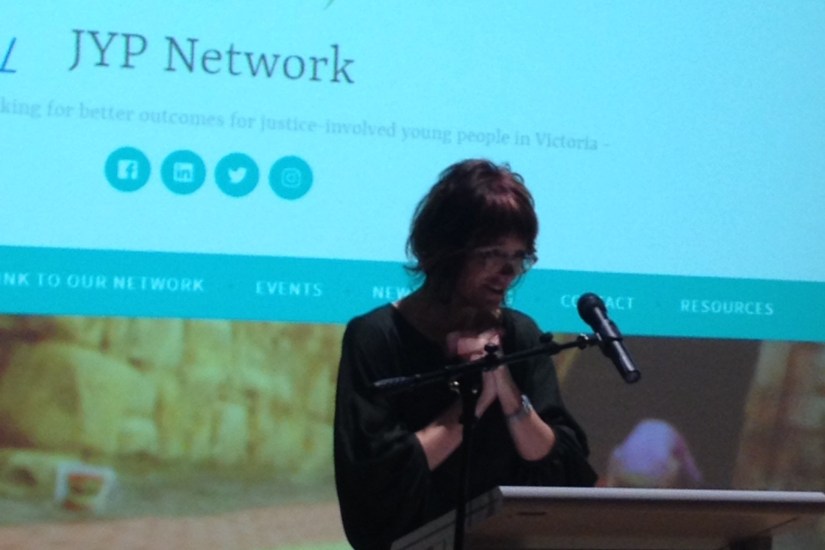
Dr Sanne Oostermeijer presenting at our network launch in 2018
Research fellow at the School of Population and Global Health, University of Melbourne and co-creator of Local Time.
When the National Gallery of Victoria and VicHealth announced the inaugural Victorian Design Challenge (VDC) with the question: ‘How might we increase the resilience of today’s young people’, it seemed to be speaking directly to me about the state of youth justice in Victoria.
During 2017 I had moved to Melbourne, after working on a project in the Netherlands exploring new forms of youth justice, which included three pilot sites for small-scale local justice facilities. Each facility explored this concept in its own way, however all three shared particular key elements: they were small-scale (max. 8 young people); local, that is, in close proximity to the young person’s family and community; and were focussed on relational security and maintaining positive elements in the lives of the young people.
Working with its key stakeholders, including the young people within the facilities, was inspiring. Everyone within these spaces seemed to have one goal in heart and mind: how can we empower these young people to create and maintain positive changes in their lives?
The experience of seeing these facilities in operation left a deep impression; I had seen that such an evidence-based policy change was possible, and that it had positive effects on both the young people and people working in the field.
In the weeks after moving to Melbourne however, I saw a different approach being advocated by media and politicians; a ‘tough on crime’ approach. This was frustrating to me, since evidence is lacking for either the ‘youth crime problem’ or the effectiveness of such a punitive approach. This was the exact opposite of the positive changes I had seen and experienced in the Netherlands.
I felt this issue pressing upon me at the time the VDC was announced, seeking design ideas to increase resilience and wellbeing in young Victorians.
The current evidence on ‘what works’ in youth justice translates closely to the idea of ‘building resilience’, so with my partner Matt (who is an architectural graduate), I began to look at how resilience could be embedded through the design of facilities for justice-involved young people.
We presented our work in June 2018, proposing the development of a design standard for small-scale, semi-open, local facilities as an alternative to high-security detention. The design standard would detail explicitly how the architecture of a facility can promote prosocial resilience and wellbeing within the justice system, based upon international research and precedents.
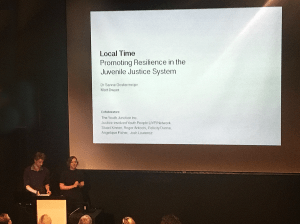
Sanne and Matt presenting at 2018 VDC
Our project, Local Time, was announced the winner of the 2018 VDC and we are now actively working towards changing the Justice system in Victoria.
Through its design, a youth justice facility embodies the ideas of the system which builds it. This in turn affects the way that services and programs can be provided within that space.
For example; if social connection is a key principle of rehabilitation, then the facility itself should be sited within or close to the youth’s community. Designing the facility on a site outside the community creates physical and psychological barriers to inclusion, and severely limits the young person’s ability to participate in the community in ways that build social connection.
We believe that we can take the first step to implementing a positive architectural model in the Victorian youth justice system by precisely articulating the key principles and requirements for small-scale local facilities, and that this can promote genuinely positive changes in the lives of justice-involved young people.
Ultimately, we hope our project will form one part of a broader reform based on the principles of justice reinvestment: re-allocating money from prisons towards communities – with a place-based, community-driven approach.
We thought we’d take a moment before we take a summer break to thank you for your support and interest in our work in 2018.
It’s been a really interesting journey since our official launch by Liana Buchanan, Commissioner for Children and Young People at the University of Melbourne in July. At the launch, she told us that it was a ‘critical time for collaboration among those committed to humane and genuinely effective approaches to offending by young people’.
Since then, we’ve been collaborating with other youth focused groups to work together to create a collective impact as we work towards better outcomes for justice-involved young people.
In October, our network co-hosted an event ‘Voices for Justice: Stories for Change: Learnings from First Nations and communities of Colour. It showcased an important report by the Koorie Youth Council: Ngaga-dji (‘hear me’) and connected young leaders.
Following on, our network became a proud supporter of the #WorthaSecondChance campaign which is fixing youth justice in Victoria.
We co-hosted an Emerging Practitioners Forum with the WorthaSecondChance, the University of Melbourne and RMIT University.
For our reflections on this year and what we hope to work towards over the next four years, listen to our interview on Mad Village.
Of particular interest to everyone who enjoyed the Free Theatre performance of ‘South Sudan Voice at our last co-hosted event last month: Free Theatre is now running workshops over summer. The workshops include training in four of Free Theatre’s applied theatre techniques – Image Theatre, Mapping, Dialogue Theatre, and The Art of Peace.
You can find out more details about the workshops here.
And for everyone interested in photography, justice, advocacy and social change, Richard Ross is presenting his photographic and advocacy work , ‘Juveniles and Justice’. The work explores the US justice system, and ways in which he has been able to effect change in the lives of young people in prison.
Presented by RMIT University School of Art, Photography, CAST (Contemporary Art & Social Transformation) and the Social Change Research Platform, this is free event on 29 November. You can find more details here.
By Dr Diana Johns, Co-convenor of the JYP Network and Senior Lecturer in Criminology; School of Social & Political Sciences, University of Melbourne
Key points
The Coalition promises to:
Arm police with 4,000 new Tasers
Have PSOs on select railway stations during the day
Reintroduce the ‘Police in Schools’ program
Introduce mandatory minimum sentencing for violent reoffending, through changes to concurrent sentences, and for additional child sex offences
Change the bail system to ‘one strike and you’re out’
Make it even harder for prisoners to get parole
Create a ‘Victorian Serious Sex Offenders Public Notification Register’
Extend support for and include victims of crime in legislative decision-making
GPS track people on parole after serving a jail term for a home invasion or car-jacking
Expand the existing Lara Prison precinct to include a new 1300-bed prison, including a 300-bed Western Victoria Remand Centre
Build an additional 300-bed Eastern Victoria Remand Centre in the Dandenong area
Fast track public security and counterterrorism measures, including new Terrorism Restriction Orders that would restrict and monitor the movement of individuals ‘in the processes of becoming radicalised towards violence’.
Labor promises to:
Continue to tackle the causes of crime, reduce repeat offending, and provide support to victims of crime
Recruit 3,135 new police officers (adding to the 20,000+ strong Victoria Police workforce that already includes 14,695 sworn officers)
Always have at least two desk officers on duty at all 108 of Victoria’s 24-hour police stations
Establish minimum requirements for the number of officers on the road and available to respond to emergency calls
Set minimum standards for crime prevention and local community engagement, custody management and ‘operational safety frameworks’ to improve officer welfare.
The Greens promise to:
Push for more funding for community legal centres and legal aid
Champion justice reinvestment approaches
Expand specialist courts including Koori Courts, Drug Courts, the Family Violence Division of the Magistrates’ Court and Neighbourhood Justice Centres
Analysis
Law and order, according to Victorian Liberal leader Matthew Guy, is the “number one issue” for many Victorians. The framing of this issue by the three major parties, however, suggests different ideas about how best to tackle issues of crime and community safety. The main emphasis of the Coalition seems to be on reactive, punitive measures involving harsher sentencing, increased reliance on imprisonment, remand and post-sentence restriction, including public disclosure of sex offenders’ details, and expanding the presence and weaponry of uniformed officers. These policies seem to assume that crime can be controlled and prevented by apprehending and locking up more people – under harsher conditions – assumptions that have been consistently proven wrong.
Labor is pledging to continue a strong record of investment in community protection, around a central theme of tackling the causes of crime to reduce reoffending. Labor has presided over a period that has seen Victoria develop the toughest bail and parole regime in Australia, restrictive youth justice policies, and substantial investment in prison-building, in firm response to community concerns about crime. At the same time as their apparently punitive policy stance, Labor has also invested significant resources in community crime prevention, which they promise to continue.
At the heart of the Greens’ justice policy are principles of social inclusion and community-building as long-term strategies to reduce crime, fear and violence. The main feature is apparently a commitment to policies that reflect up-to-date evidence about ‘what works’. Alongside an emphasis on human rights and access to justice, the Greens have a strong focus on police powers, their main concerns being to curb police militarisation and increase police accountability.
The law and order paradox
Since 2014, when the Andrews Government was elected, Labor’s tenure has been marked by a law and order paradox.
On one hand, the number of people committing offences – particularly youth crime – has dropped. On the other, community concern about violence has intensified, largely due to media narratives that exacerbate public fears and magnify misperceptions about the extent and scale of the supposed ‘crime problem’.
While increases in criminal incidents in Victoria can be linked to increased reporting of family violence and sexual offences, for instance, public fears seem to reflect racialised crime myths perpetuated by media stories about ‘African gangs’, ‘Apex’ and ‘Moomba riots’. Serious and persistent non-racialised crime problems have been downplayed in favour of these more sensational headlines.
Another driver of public fear about crime and safety are the rare but shocking incidents of violence perpetrated by individuals, such as the horror that unfolded in Bourke Street on Friday afternoon, 9th November, which reignited terrifying memories of James Gargasoulas mowing down innocent pedestrians 22 months earlier.
These events spark fears about the government’s capacity to keep us safe. When the perpetrator is black and Muslim, those fears fuel further racialised crime myths.
Similar acts of violence have triggered legislative responses. The case of Sean Price, for example, who in 2015 murdered 17-year-old Masa Vukotic then raped another woman days later while under Department of Justice supervision. This case intensified public fear already heightened by the 2012 rape and murder of Jill Meagher by Adrian Bailey who had also been under Department supervision.
The resulting bail and parole reforms – under Coalition and Labor governments – have increased remand populations, intensified pressure on prison capacity, and thereby provided political justification for more prisons.
Given the abundant evidence of the crime-causing effects of imprisonment, however, not least the failed US experiment in mass incarceration, any attempt to ‘jail our way out of crime’ can be seen as deeply flawed policy.
Evidence-free policy
Fuelling public fears about ‘law and order’, the LNP has been mounting a campaign of reactive and punitive strategies, apparently aimed at deterrence and public protection. What is striking is the lack of reliable evidence to support these policies.
In response to this month’s Bourke Street attack, Matthew Guy has promised to ‘fast track’ laws to introduce Terrorism Restriction Orders, expanding police powers to try and control people who ‘may be developing terrorist behaviours’. This seemingly ignores the Harper Lay Report’s emphasis on community-wide collaborative approaches to preventing terrorist threats.
The ‘Police in Schools’ program was discontinued in Victoria over a decade ago and replaced by targeted police presence, via the Youth Resource Officer program, which aims to build trust with ‘at risk’ youth via strategic relationship-building activities.
The rising numbers of people on remand – in youth and adult prisons – have been associated with increased volatility and violence, yet the LNP is proposing to increase remand capacity, with no acknowledgement of these significant public safety risks – both for prison management and for the communities to which people are released from custody.
Evidence-based policy
In contrast, the Greens’ policies reflect evidence about longer-term strategies that reduce crime and its underlying causes, such as justice reinvestment, a data-driven approach to community-based crime prevention that aims to redirect money spent on prisons to the communities that feed prison populations.
This approach has been trialled in Bourke, NSW, since 2013 and has shown remarkable results in reducing crime, most notably domestic violence and drug offences.
Police play an important role in maintaining law and order, but key to this role is the issue of legitimacy – the community’s ability to maintain trust and confidence in police. Recent controversy about police misconduct has brought police legitimacy into question, however, particularly in terms of oversight and accountability.
Whereas Labor and the Greens echo the recent parliamentary inquiry’s recommendations about independent oversight and investigation of police complaints, this is a striking omission in Coalition policy announcements, which have instead focused on extending the presence of Protective Service Officers (PSOs) and the numbers of police who can use Tasers to apprehend suspects. In contrast, the Greens explicitly argue against further police militarisation and for limiting the use of electroshock weapons to life-threatening situations.
As the success of Bourke’s justice reinvestment project suggests, police are most effective when they engage and collaborate with the communities they are policing, using a problem-solving approach to address the underlying causes of crime problems.
Labor’s pledge to apply ‘a systemic approach to tackling high-harm offending’ appears to reflect this understanding, as does the Greens’ emphasis on the importance of police ‘with strong community links and a focus on maintaining a safe, peaceful and just society’.
Taking the long view
Short-term electoral cycles hamper effective responses to crime. This may explain the Coalition’s emphasis on reactive policies, which feed into community fears, rather than relying on evidence about what works to ensure community safety.
In terms of the courts, the LNP is focused on curtailing judicial discretion, proposing mandatory minimum sentencing and scrapping concurrent sentences, for instance.
In contrast, Labor and the Greens promise to support and expand specialist courts and programs shown to reduce offending and reoffending. Whereas Coalition crime prevention policy revives and reinforces outdated programs and ineffective approaches, Labor’s community engagement strategy recognises the need to work actively ‘upstream’ of the problem through early intervention.
Effective justice policy takes the long view of crime as a social problem that requires investment in communities.
Dr Diana Johns
This article was originally published on Election Watch, providing non-partisan, fact-based, expert analysis of key elections based at the University of Melbourne.









 JYP Network